Practical guide
Recording a Dream on Waking: Recall, Gaps and Uncertainty
Keep the fragment you remember, mark uncertainty beside the detail, and separate the first note from later recollections or suggestions. Includes two original cards, fictional timelines and the limits of a morning-recall study.
Start with a fragment, a recall state and the time of the note
When convenient after waking, write the fragment you actually remember, attach uncertainty to the unclear detail, and keep later additions underneath with their own time. A few words are enough. You do not need a complete plot, an interpretation or an exact clock reading before the note is useful.
For example: “Station platform; a person in a coat, perhaps green. Ending not remembered. First note shortly after waking; time not checked.” This describes the present recollection without making the coat colour certain. It also avoids inventing a destination or an ending.
This guide focuses on the history of a record: what was written first, what remained missing, and what was added later. Use the general dream journal if you mainly want separate detail, emotion and association columns. The two tools can be used together; there is no need to duplicate an entry.
The NINDS sleep overview explains that people may not remember most of their dreams. A short entry or no recalled dream is therefore not a failed assignment. This original record system is a writing aid, not a tested recall treatment or a way to verify what happened during sleep.
Distinguish a fragment, missing content and a missing entry
Before expanding the scene, choose wording that fits what you can report now. A remembered fragment and the feeling of having dreamed without remembered details are different entries. A day without an entry gives less information than either.
| Situation | Useful entry | What stays unknown |
|---|---|---|
| A fragment is remembered | I remember a platform; the train destination is not remembered. | The missing parts and the full sequence. |
| You feel you dreamed, but have no content | I woke with the feeling that I had dreamed; no details recalled. | The content, length and meaning of the experience. |
| No dream is recalled | No dream recalled when I made this note. | Whether dreaming occurred earlier in the night. |
| No note was made that day | No entry available. | The recall state at waking. |
| The first note is made much later | First note made at lunchtime; waking details and timing uncertain. | What would have been reported immediately after waking. |
These are ordinary recording labels, not clinical categories. Do not diagnose a memory or sleep condition from which label appears most often. Nor does “no dream recalled” establish that the whole night was dreamless.
If you remember only a feeling, describe that feeling and the missing content. You do not need to turn it into a scene. If the note itself is missing, leave that gap instead of filling it retrospectively with “no dream.”
Mark confidence for the detail, without giving an accuracy percentage
Write “clearly remembered,” “perhaps,” “not remembered,” or “inferred afterward” beside the relevant detail. These labels describe your present sense of recall. They are not calibrated accuracy ratings, and a vivid or confident memory is not independently verified by the label.
| Component | Useful wording | Avoid silently upgrading it |
|---|---|---|
| Setting | I remember a station; which station is unknown. | Naming your usual station because it seems plausible. |
| Colour | Coat perhaps green; colour uncertain. | Green coat stated as a settled detail. |
| Identity | A person waved; face not remembered. | Identifying a friend from a later association. |
| Sequence | I remember the platform and then a room; the transition is missing. | Inventing a journey to connect the two fragments. |
| Explanation | Later association: yesterday’s trip comes to mind. | Claiming the trip caused the dream. |
A single “maybe” at the bottom of an otherwise definite story is hard to interpret. “The person’s identity is uncertain” is more useful because it identifies the unresolved part. Several details can carry different qualifiers within the same entry.
There is no need to assign a score such as “90% accurate.” Without an independent record of the dream and a validated scoring procedure, that number would suggest more precision than this sheet supplies. You may feel more or less sure when you revisit the note; retain both the original wording and the later change.
Keep waking time, recording time and later changes separate
If known, record the date of waking and the time of the first note. If you estimate a time, say so. You do not need to check a clock, set an alarm or remain awake to make the fields exact. “After breakfast; wake time not checked” is an honest timing note.
Choose writing or a short voice note according to what suits you. A voice recording contains what you said after waking; it is not an audio recording of the dream. If software transcribes it, distinguish the recording from an unchecked transcript, and correct transcription errors against the actual audio when available.
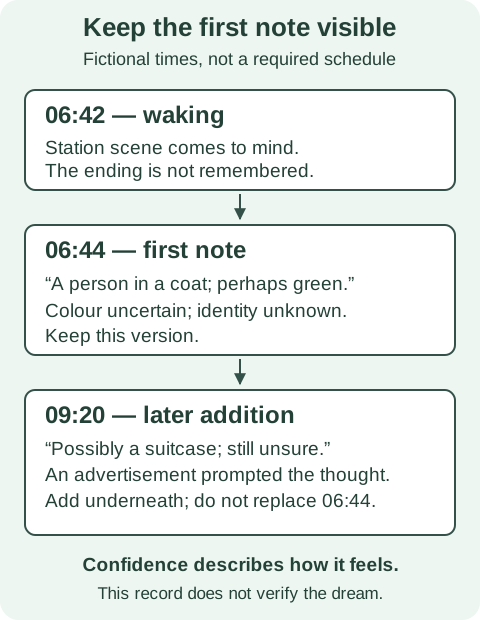
A later addition needs its own date or timing estimate and a label: later recollection, association, external suggestion or typing correction. Include what prompted it if you know. A suggestion from another person, a dictionary or an AI system belongs in the suggestion field; it cannot supply a verified missing detail.
Correct an ordinary typo without treating it as new dream content. If the remembered colour changes from “perhaps green” to “perhaps blue,” preserve the first version and add the second. A visible revision history is more informative than an apparently certain final story.
Two worked timelines show how to preserve an unresolved record
Both examples below are fictional. They illustrate record keeping, not observed reader experiences, laboratory findings or fixed dream meanings.
Example 1: a later object with a known prompt
| Moment | Record | What this establishes |
|---|---|---|
| 06:42, waking | Station fragment comes to mind. | A reported recollection at waking; not a complete scene. |
| 06:44, first written note | Platform; person in a coat, perhaps green; ending not remembered. | What was recorded first, including the uncertainty. |
| 09:20, after seeing an advertisement | Later recollection: possibly a suitcase. The advertisement prompted the thought; still unsure. | A later thought and its known prompt, not verified suitcase presence. |
| When reviewing | Retain both notes; suitcase unresolved. | A record with a visible addition rather than a silently completed story. |
The advertisement could be relevant to when the thought arose. That fact alone does not prove that the suitcase was absent from the dream or present in it. “Unresolved” is a useful outcome; you do not have to select one definitive version.
Example 2: no first note, then a lunchtime association
| Moment | Record | Keep the limit visible |
|---|---|---|
| Morning | No note was made. | The morning recall state was not recorded. |
| Lunchtime | First note: a bridge comes to mind while discussing yesterday’s walk. | This is the first surviving note, made later. |
| Same note | I think it may be a dream fragment; uncertain. The conversation prompted it. | Possible recollection and association remain distinguishable. |
| When reviewing | Do not label this an immediate waking report. | Neither a complete recovered dream nor proof of no morning recall. |
A late note can still be personally interesting. Labeling its timing does not make it worthless. It simply preserves the difference between a note made near waking and a thought written much later, instead of pretending that the two were collected in the same way.
What one morning-recall study can tell you—and what it cannot
In a 2025 study by Valentina Elce and colleagues, 217 healthy Italian native-language-speaking adults aged 18–70 were recruited; 204 remained in the analyzed sample after protocol and minimum-recording exclusions. Participants were asked to make morning voice reports over 15 days, focusing on the last experience before waking. This was a specific research procedure, not a trial of this worksheet.
The authors separated reports with content, the perception of having dreamed without recalled content, and reports of feeling that no dream had occurred. They also excluded delayed daytime recall reports because waking stimuli and events might trigger or distort those memories. That choice explains an important method boundary; it does not prove that every late recollection is false.
The study found associations between reporting a dream and factors including attitude toward dreaming, mind wandering and sleep patterns. Its discussion explicitly leaves the causal relationship between interest in dreams and recall open. More interest could accompany more recall in different ways; the result does not establish that filling this card causes better memory.
| Research detail | Useful implication for this record | Limit |
|---|---|---|
| Morning voice reports, last experience before waking | Label when and how the note was made. | Not a complete inventory of all dreams that night. |
| Delayed reports excluded from the analysis | Keep later notes visibly separate. | Not proof that each delayed detail is incorrect. |
| Definitions and oral versus written reporting discussed as limitations | Use consistent labels when comparing your own notes. | Different methods can change estimates; no universal recall target follows. |
| Selected healthy adult sample; portable sleep instruments | Describe the population and measurement limits. | Not a diagnostic rule or a prescription for children, illness or treatment. |
The authors note that recording methods and definitions can affect recall estimates, and that portable sleep devices have lower reliability than standard laboratory polysomnography. The paper therefore cannot certify a dream detail or turn a personal note into a sleep-stage measurement. This guide does not recommend changing sleep duration, medication or awakenings to chase its findings.
Review the notes you have, and attend to actual sleep problems
When reviewing, summarize the records rather than all presumed dreaming. In a fictional four-day set, there is one fragment note, one “felt I dreamed, no details” note, one “no dream recalled” note and one day with no entry. You have three notes across four days. You do not have evidence that only one dream occurred, or that the unrecorded day had no recall.
Changing from a long narrative to short fragments, writing at a different time, or changing the labels also changes what you are counting. Describe the change before claiming a trend. A small personal record cannot establish an improvement rate, a cause of memory variation or an expected number of dreams per night.
Stop when the note has done its job. There is no required streak, minimum word count or obligation to recover a missing ending. If analysis becomes upsetting or interferes with sleep, shorten it or leave it aside. Keep identifying details private when sharing a fragment; it does not reveal what another person actually thought or did.
The NHS advises adults to see a GP for regular nightmares that affect sleep and everyday life. Its sleep-diary suggestion includes sleep duration, time taken to fall asleep and how you feel the next day. Discuss those actual effects when relevant; decoding a scene or completing this recall card is not a prerequisite for help. This record is not a clinical assessment.
Copy the two cards and try six recording decisions
Use the first card once, then put additions in the second. Unknown and estimated fields are acceptable. Both cards can be shortened to fit a private note; neither is a test.
DREAM RECALL — FIRST NOTE
Date of waking:
Wake time: known / estimated / not checked:
Time of this first note: known / estimated / not checked:
Recall state: fragment / felt I dreamed, no details / no dream recalled:
Fragment actually remembered, in my own words:
Specific uncertain detail and its qualifier:
Detail not remembered; leave the gap:
Dream feeling / waking feeling, if remembered:
Recording method: written / voice; transcript checked or not:
Keep this first version; no interpretation is required.
DREAM RECALL — LATER ADDITION
Date and time of this addition, or estimate:
Kind: later recollection / association / suggestion / typo correction:
The original detail this concerns:
New wording, with uncertainty attached to the detail:
What prompted this thought, if known:
Source of a suggestion or lookup, if used:
What remains unresolved:
First note retained at:
A later thought does not automatically verify a missing dream detail.
Download both cards, the worked examples and six explained checks (TXT). The download contains these original materials and source links.
Case 1
You remember a platform but not the destination. Your usual station seems likely. Should the first note name it as certain?
Show answer and explanation for case 1
No. Record the platform and leave the station or destination unknown.
A plausible waking inference is different from a remembered detail. Label it separately if you want to keep it.
Case 2
You feel you dreamed but cannot recall any scene. Is that the same entry as no note made that day?
Show answer and explanation for case 2
No. Keep the feeling of having dreamed with no details as its own recall state.
A missing entry does not tell you what the recall state was. The two records provide different information.
Case 3
You wrote “perhaps green” in the morning and think “perhaps blue” later. Should the later colour replace the first one?
Show answer and explanation for case 3
Keep the first note and add the later colour with its time and uncertainty.
The revision records a changed recollection; neither colour is independently verified by the record.
Case 4
A lunchtime conversation prompts a bridge image, and there was no morning note. Can it be labelled an immediate waking report?
Show answer and explanation for case 4
No. Label it as the first note made at lunchtime, with its known prompt and uncertainty.
It can remain useful without backdating it or claiming a morning record that does not exist.
Case 5
A detail feels very vivid. Can the card call it 95% accurate?
Show answer and explanation for case 5
No. Describe the detail as vividly or clearly recalled without inventing an accuracy percentage.
A feeling of confidence is not a calibrated measure of accuracy or an independent record of the dream.
Case 6
Regular nightmares affect sleep and daytime life, but the dream ending is missing. Must you recover the ending before asking for help?
Show answer and explanation for case 6
No. Seek help for the actual sleep and everyday effects.
The NHS adult help guidance does not require an interpretation or complete dream transcript first.
Sources and further reading
- NINDS: Brain Basics — Understanding SleepGeneral dream recall and unknown purpose of dreaming; not validation of these cards.
- Elce and colleagues (2025): The individual determinants of morning dream recallMorning oral-report methods, study population, reporting distinctions and methodological limits; does not validate this worksheet or certify recalled details.
- NHS: Night terrors and nightmaresAdult help guidance for regular nightmares affecting sleep and everyday life, and sleep diary fields; not a diagnosis from the dream.